
How to Study Like an Athlete: A College Exam Study System That Actually Works
Nobody tells a varsity athlete to 'just try harder on game day.'
They train. They drill. They build systems that make peak performance repeatable, not something they cross their fingers and hope for when it counts.
So why do we tell college students to 'study more' before an exam without ever teaching them how?
The students who consistently perform well on exams aren't necessarily the smartest people in the room. They're the ones who treat studying the way athletes treat training, with structure, intention, and a system that holds up under pressure.
Here's how to build yours.
Principle 1: Train in Conditions That Match the Game
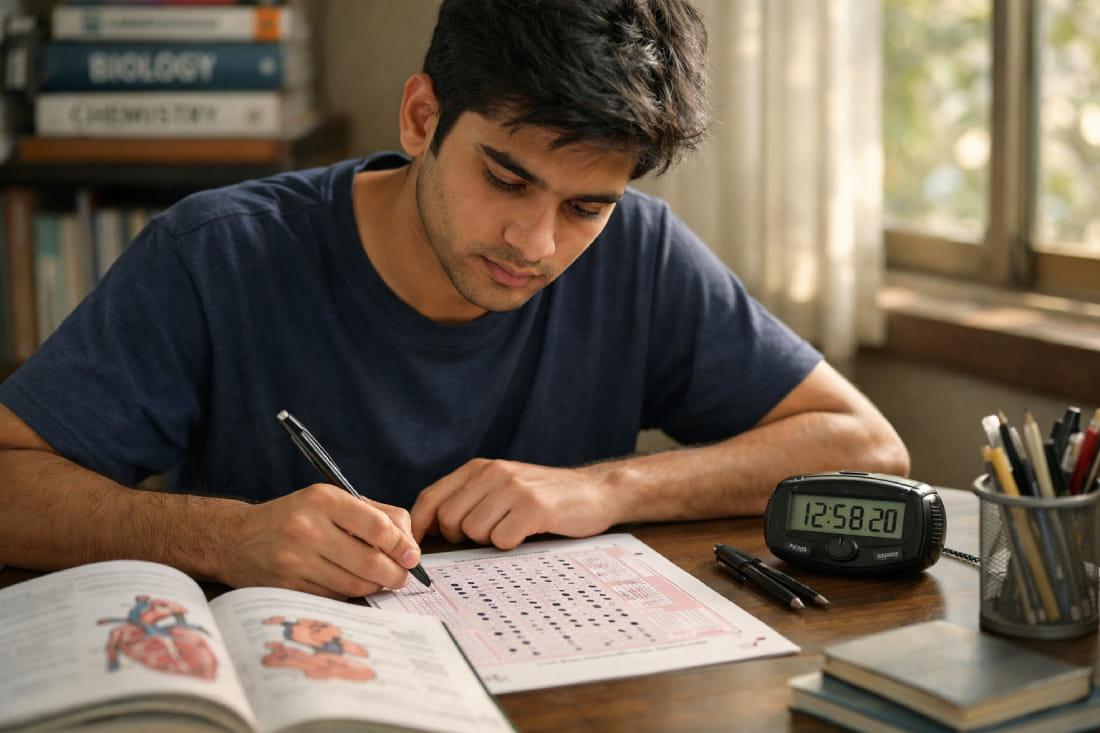
Athletes don't practice in perfect conditions and then perform in chaos. They simulate game conditions in training so their body and mind know exactly what to do when it matters.
The same principle applies to studying for exams.
If your exam is timed, practice with a timer. If it's closed-book, study without your notes. If it's in a quiet lecture hall, don't do all your studying with music and notifications on.
Study in silence sometimes — especially for subjects that require deep focus
Practice retrieving information without looking at your notes before you think you're ready
Time yourself on practice problems so the clock doesn't feel like a surprise on exam day
If possible, review material in the same room where the exam will be held
Your brain learns context. The more familiar the environment feels on exam day, the more access you have to what you actually know.
💡 This is one of the most underused study strategies in college. Match your practice conditions to your performance conditions — and watch your exam anxiety drop.
Principle 2: Prioritize Recovery, Not Just Reps
Elite athletes don't train 24 hours a day. They train hard, then recover, because recovery is where the gains actually happen.
Students who pull all-nighters before exams are doing the equivalent of running a marathon the night before a race. You're not building capacity. You're draining it.
What recovery looks like for students:
Seven to eight hours of sleep, especially the night before an exam. Memory consolidation happens during sleep. This is not optional.
Study blocks of 45 to 90 minutes with genuine breaks in between, not 'breaks' where you scroll for three minutes and feel guilty
At least one full rest day per week where you step away from coursework entirely
Movement — even a 20-minute walk improves recall and reduces cortisol levels that interfere with memory
💡 The student who sleeps 7 hours and studies 4 focused hours almost always outperforms the student who stays up until 3am cramming. Recovery is part of the system.

Principle 3: Use Game Film — Review What Went Wrong
After every game, athletes watch film. Not to feel bad about mistakes — to understand them, correct them, and not repeat them.
After every exam, do the same.
When you get a graded exam back — especially one that didn't go the way you wanted — sit with it and ask:
Were the questions I missed ones I didn't study, or ones I studied but couldn't retrieve under pressure?
Did I run out of time, or did I struggle with the material itself?
Were there patterns in my wrong answers — same concept, same type of question?
Did I misread questions, or did I genuinely not understand the content?
The answers tell you exactly what to adjust for the next exam. Students who skip this step are condemned to repeat the same mistakes and wonder why their grades don't improve even when they study more.
Principle 4: Know Your Position — Play to Your Strengths
Not every athlete plays every position. The best coaches put players where their strengths create the most value for the team.
The academic version of this is knowing how YOU learn best and building your study system around that, not around what everyone else is doing.
Are you a visual learner? Diagrams, color-coded notes, and mind maps will serve you better than reading the same paragraph five times.
Are you auditory? Record yourself summarizing a concept and play it back. Teach it out loud to an imaginary student.
Do you learn by doing? Practice problems and application exercises will beat passive re-reading every time.
The goal isn't to study the most. It's to study in the way that produces the most understanding and retention for your specific brain.
💡 If you've never thought about your learning style as it relates to your study system, that's the first conversation to have inside College Time Hacker. We build around how you actually work, not a generic template.
Principle 5: Have a Pre-Game Routine
Elite athletes have pre-game routines. Not superstitions, intentional rituals that signal to their brain and body: it's time to perform.
Build one for exams.
It doesn't have to be complicated. It just has to be consistent:
A specific breakfast or meal you eat before exams
A playlist or silence practice for the 30 minutes before you walk in
A quick five-minute brain dump of everything you remember about the topic before you open the test
A breathing or grounding practice if anxiety is part of your exam experience
Consistency builds confidence. When your brain recognizes the routine, it shifts into performance mode faster, because it's done this before.
The System Is What Separates Good Students From Great Ones
Talent matters. But in college, just like in athletics, talent without a system only gets you so far. The students who finish the semester strongest aren't always the ones who started with the most knowledge. They're the ones who built a process and trusted it.
If you want help building that process, one that's personalized to your learning style, your schedule, and your specific exam challenges — that's exactly what the College Time Hacker is designed for.
👉 Learn more about the College Time Hacker
Rooting for you,
Dr. JoNataye Prather (Coach Dr. J)

join the Private mentorship group

***DISCLAIMER: Coach Dr J provides educational content and guidance for general informational purposes. While we strive for accuracy, we make no guarantees regarding the completeness, accuracy, or suitability of the information provided. Use the information and materials at your own risk. We are not responsible for any loss or damage, including indirect or consequential loss, arising from your use of this website or the Coach Dr J products.***
Copyrights 2026 Dr JoNataye™ College 2 Career Blueprint | Terms and Conditions | Privacy Policy Built By: WebsterBerryMarketing.com
Facebook
Instagram
LinkedIn
Youtube